April 2, 2026
No guessing. No assumptions. Just a full picture first.
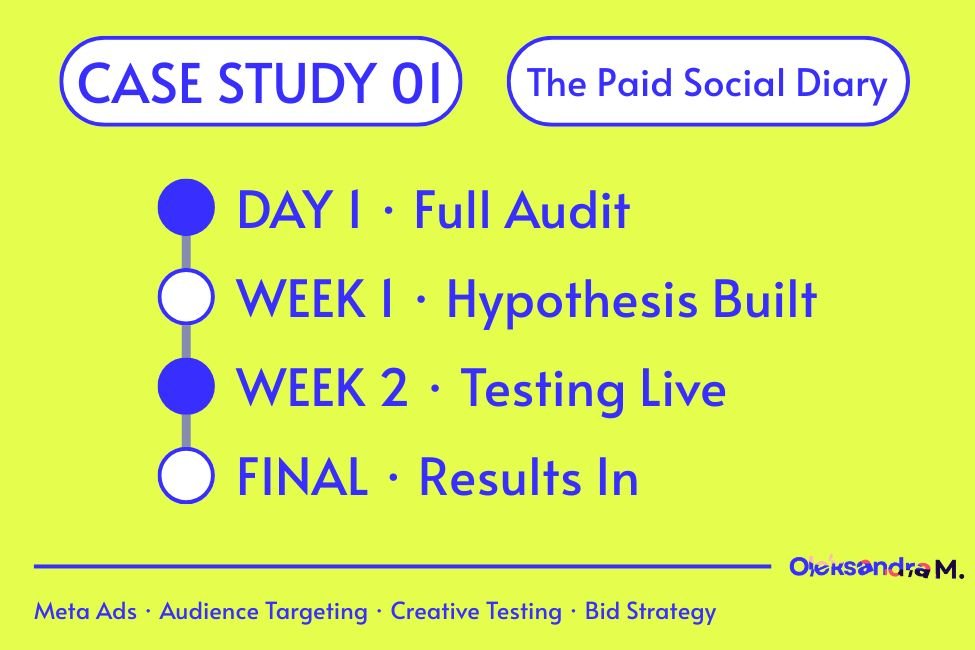
I always start the same way regardless of what I am looking at. I need to understand the full picture before I touch anything. Not because I am cautious. Because I am strategic. Every decision I make needs to be backed by something real. Not a gut feeling dressed up as experience. Actual data. Actual evidence. Actual understanding of what is happening before I form a single opinion about what needs to change.
This is the diary of one of those campaigns. The names are protected. The methodology is completely mine.
DAY 1: The Full Picture
The first thing I do when I enter any paid social account is nothing. I sit with it. I read it like a book. Structure, naming conventions, audience setup, budget allocation, creative library, reporting setup. Everything.
Most people want to jump straight to fixing. I want to understand first. Because the worst thing you can do in a paid social account is make changes before you understand why things are the way they are. Sometimes what looks broken is actually intentional. Sometimes what looks fine is silently bleeding money.
Here is what my Day 1 audit checklist looks like every single time:
The audit told me one thing very clearly. The budget was being distributed across audiences that were far too broad. The campaign was technically running. It was just running for everyone, which in paid social means running for no one.
That was my full picture. Now I could form a hypothesis.
WEEK 1: The Hypothesis
A hypothesis in paid social is not a guess. It is a structured prediction based on evidence. Mine looked like this:
If I narrow the audience targeting to higher intent segments, restructure the ad sets to eliminate overlap, and introduce creative variation across different formats, the cost per result will decrease while conversion quality improves.
Simple. Specific. Measurable. That is all a hypothesis needs to be.
The decision I made next is where most people and I say this without judgment get it wrong.
The hypothesis was built. The structure was rebuilt. The creatives were ready. Now came the part that requires something most marketers underestimate completely.
Patience combined with obsessive attention.
WEEK 2: Testing Live
Going live is not the finish line. It is the starting gun.
The first 72 hours of a rebuilt campaign are the most information dense period you will ever have. Everything you built is being tested against real humans in real time. And real humans do not always behave the way you predicted.
This is what I was watching every single day during Week 2:
Frequency. If an audience is seeing the same creative more than twice in 7 days the creative is already fatiguing. Rotate immediately.
Cost per result by ad set. Not overall. By ad set. One winning audience at this stage is more valuable than three mediocre ones.
Landing page drop off. If the ad is clicking but not converting the problem is not the ad. The problem is what happens after the click.
Relevance signals. Meta tells you how your creative is performing relative to what your audience expects to see. Low relevance means wrong message for wrong audience.
This is what daily attention actually looks like in practice. Not checking once a week and hoping for the best. Showing up every single day and reading what the data is telling you before it becomes an expensive problem.
FINAL: Results In
Within two weeks the data was speaking clearly.
The three audience segments performed completely differently from each other. One segment dramatically outperformed the other two in conversion quality. Not just volume. Quality. The leads coming from that segment were more qualified, more engaged, and more likely to take the next step.
The creative rotation prevented fatigue. Frequency stayed controlled. The audience never got bored of seeing the same thing because we never let them see the same thing twice in the same week.
The cost per result dropped consistently across the optimized ad sets. Not because we spent less. Because we spent smarter. Every dollar had a job and every dollar was being monitored.
This is what I mean when I say I need to understand the full picture before I touch anything. Because when you understand the full picture you know exactly what to change, what to test, and what to leave alone. And when you combine that understanding with disciplined daily attention the results follow.
Not because of luck. Because of method.
The Takeaway
Every campaign I touch starts the same way. Full picture first. No exceptions.
Because the fastest way to waste a budget is to start making changes before you understand what you are actually looking at. And the fastest way to build something that works is to be disciplined enough to understand the problem completely before you propose the solution.
The methodology is not complicated. But it requires something that cannot be automated, templated, or rushed.
It requires showing up every single day and actually thinking.